
AI Didn't Make Product Research Easier
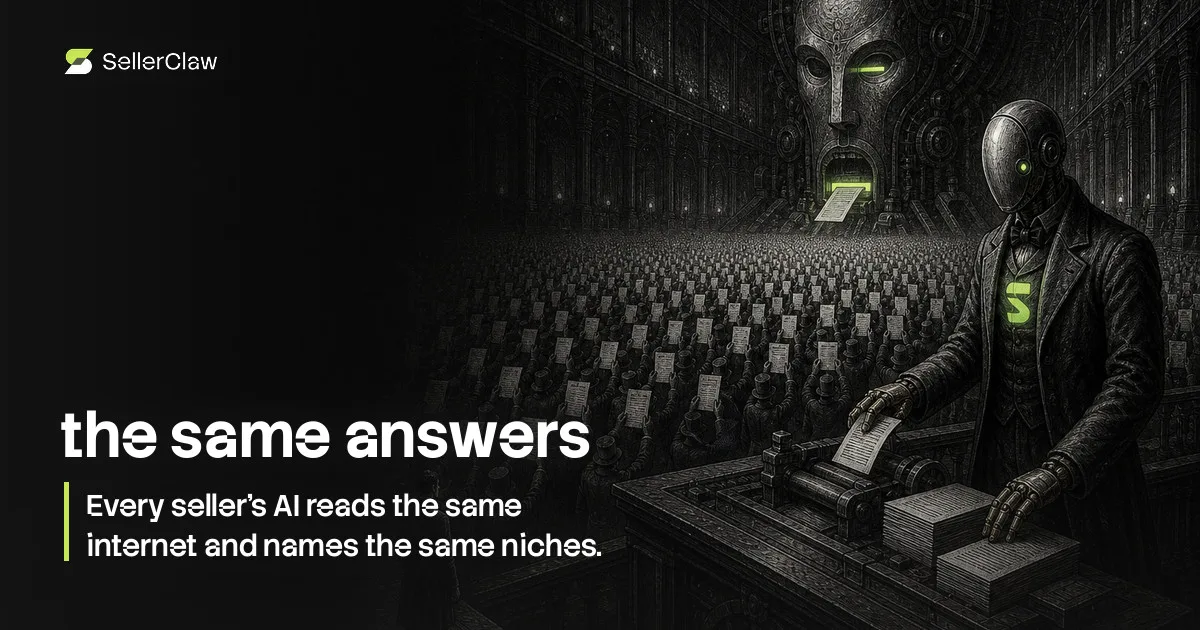
Ask any general-purpose assistant what to sell this autumn. Then ask a different one. Then ask a friend who sells online to ask theirs.
You will get the same categories, phrased differently. Not because the models are lazy, but because they are reading the same public internet and optimizing for the same thing: an answer that is defensible. Defensible means popular, and popular means somebody is already selling it at a price you cannot match.
That is the trap in the current enthusiasm about AI-assisted sourcing. Research got faster for everyone at the same moment, which means the output of research stopped being an edge. A product idea that is one prompt away from anyone is a queue.
Right-hand panel: the inputs a sourcing decision actually turns on.
The timing math is brutal
Say the model is right and the category is genuinely growing. You still have to buy it.
Between "found it" and "have it in stock" sit sampling, a supplier conversation, a payment, and weeks of freight. Every other seller who typed the same question is running the same clock, from the same starting gun, and several of them started earlier and buy in larger quantities than you do.
By the time your first units land, the listing page is crowded and the only lever left is price. This is the mechanism behind every product that looked brilliant in a research tool and arrived into a price war.
None of that is an argument against using AI for sourcing. It is an argument against expecting the idea to be the valuable part.
What a general model structurally cannot know
Here is that right-hand panel in full. A public model knows what the public internet knows. It does not know:
- what a unit actually costs you, landed, with shipping from your supplier's warehouse and this week's exchange rate;
- what your buyers returned last year, and the reason they gave;
- which of your listings have been asleep for twelve months while still consuming ad budget;
- what your supplier can really ship in October, as opposed to what the catalog page claims;
- how close your account is to a marketplace threshold that would make an aggressive launch a bad idea.
Every item on that list is private, boring, and specific to you. Every one of them changes a sourcing decision more than a trend graph does — and none of them is in the answer you get from a chat box that has never seen your store.
This is also why "revenue is up" is such a poor input for a sourcing decision when nobody has told the system what things cost. Growth in a category you lose money on is a reason to buy less, not more.
The research that is still yours alone
The version of product research that survives is unglamorous and inward-facing.
Look at what you already sell, one product at a time, with the real cost in front of you. Read the complaints under competing products — a recurring complaint is a specification, and it is the one thing your listing can say that theirs cannot. Check what your existing buyers asked for and you did not have. Look at your own dead tail before you add to it.
That work is no harder than prompting; it is just done on data nobody else can query, which is precisely what makes it worth doing. Finding a product was always the easy half; the half that decides the outcome is the arithmetic afterwards.
An AI is genuinely good at this — but only one that is looking at your numbers rather than at the internet's. That is what SellerClaw is: a team of AI agents connected to the stores you already sell on, along with your suppliers, that you talk to in a chat. Asked whether a product is worth reordering, it answers from your orders, your supplier's current cost and your returns, and says "unknown" where it has not been told the cost — rather than producing a confident number that would be somebody else's.
Connect one store and ask which of your products actually made money last quarter. The free credits cover it, and the answer will be about your business specifically — which, right now, is the only kind of answer that is still scarce.
Keep reading
Connect one store and see what your agent says about it.
Start for Free