
AI Agent vs Chatbot vs Copilot: Which One Does Your Store Need?
A seller we spoke to had been pitched three AI products in the same month. One wrote product descriptions. One lived inside their store admin and suggested things. One claimed it would run the store.
Every demo looked the same from the outside: a text box, a confident answer. The prices did not look the same at all, and neither did the permissions each one asked for.
The words being used — chatbot, copilot, agent — are marketed as three levels of intelligence. They are not. They are three amounts of access to your business, and access is the only one of the three that changes what happens on a Tuesday. Sorted that way, the choice takes about a minute.
What a chatbot is: it knows only what you type
This is the category most people have already used. You describe a situation, it writes something back. It is genuinely good at language: descriptions, email drafts, translating a policy into plain words, summarizing a supplier's message.
Its limit is not intelligence — the same underlying model may be the smartest of the three. Its limit is that it has no idea whether anything you told it is true.
There is a simple test for this category: a chatbot can never tell you that you are wrong about your own numbers. Say your quarter was great and it will help you plan for a great quarter. It has no way to check, so agreement is the only move available.
That is the shape of the thing, and no better prompt fixes it. Everything it knows about your business arrived in the last few messages, from you, unverified — which also means the quality of its answer is capped by the quality of your description, and you are the one person who cannot see your own blind spot.
For writing tasks, that is fine and you should not pay more for anything else. For decisions, it is a well-informed friend who has never seen your books — and who is handing the same advice to everyone else who asks.
A copilot works inside one tool
A copilot sits in an application you already use — your store admin, your ad manager, your spreadsheet — and helps within it. It can see what is on the screen and often the data behind it, so unlike a chatbot it can be specific: this campaign, this product, this row.
Two limits come with that. It stops at the edge of the app it lives in, and it usually stops at suggesting. You still press the buttons.
The edge is the bigger problem, because most e-commerce trouble is made of two facts that live in different systems. Your marketplace account health is in one place, the unfulfilled orders that are wrecking it are in another, and your supplier's shipping delay — the actual cause — is in your email. A copilot in any one of those three sees a third of a problem.
And a third of a problem is not a third as useful; it is often worse than nothing, because it produces a confident recommendation about the wrong cause. The ad copilot tells you to raise the budget on a campaign that is converting badly because the item has been out of stock at the supplier for a week.
What makes an AI agent different: credentials and permission to act
An agent is given access to your systems and permission to do things in them. That is the entire difference, and it is a much bigger one than it sounds.
It changes what a question can return. Ask a chatbot how your store is doing and you get a framework. Ask something connected to your store and it can answer with your numbers — including the answer you did not want, like the fact that a quarter's growth was one lucky sale.
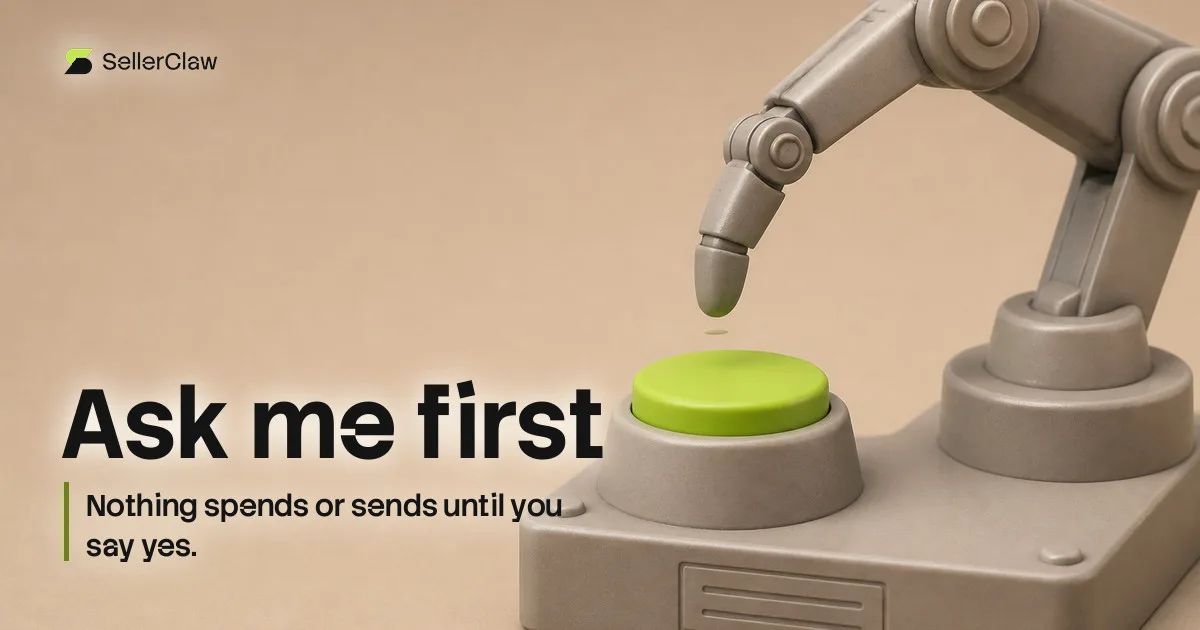
It also changes what happens between conversations. Work can continue while you sleep, which is the actual point, and also the reason the honest question about an agent is not "how smart is it" but "what can it do without asking me". That should be a setting you can see, with money and messages sent in your name on the far side of your approval.
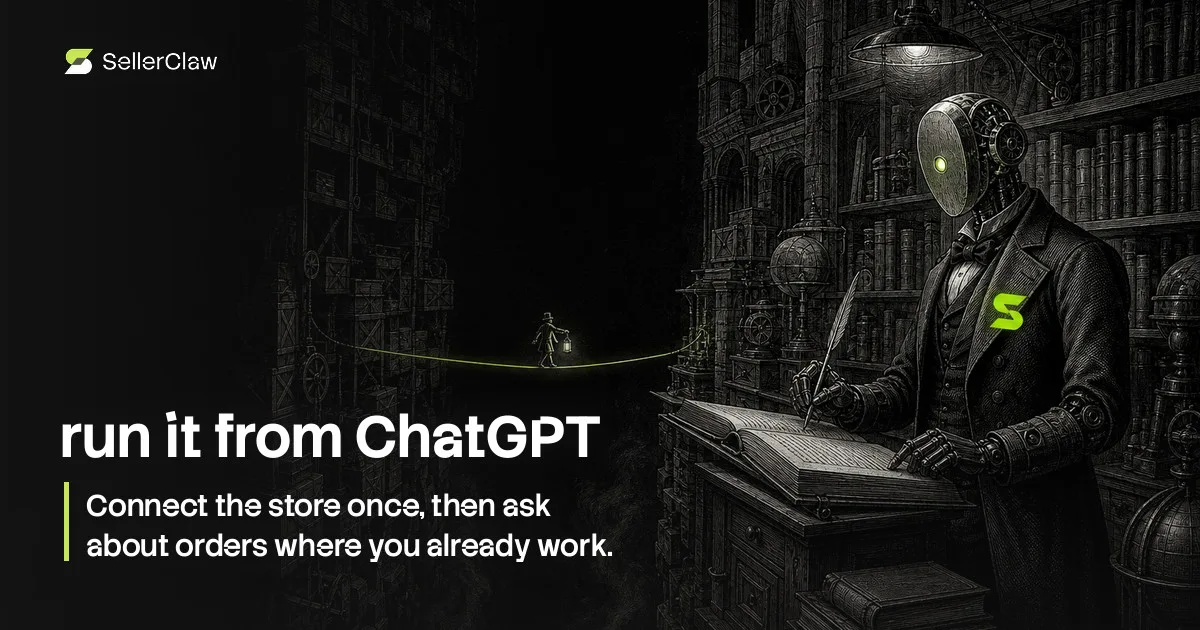
One piece of jargon is worth decoding here, because it explains a change you may have noticed. If ChatGPT or Claude has suddenly become able to read your orders, that is usually MCP — a shared standard for handing an assistant a set of tools it can call, with the actual permission checks staying on the server that owns the data. It is why "bring your own assistant" is now a normal thing to do, and why the tool list an assistant offers can grow without the assistant itself changing.
It is also why the three words have started to blur. The same ChatGPT window is a chatbot when you paste a paragraph into it and an agent when it is holding your store's credentials. What decides the category is the connection.
The grey line in each band is the test — it is what tells you which of the three you are being sold.
AI agent vs chatbot: so which one does your store need?
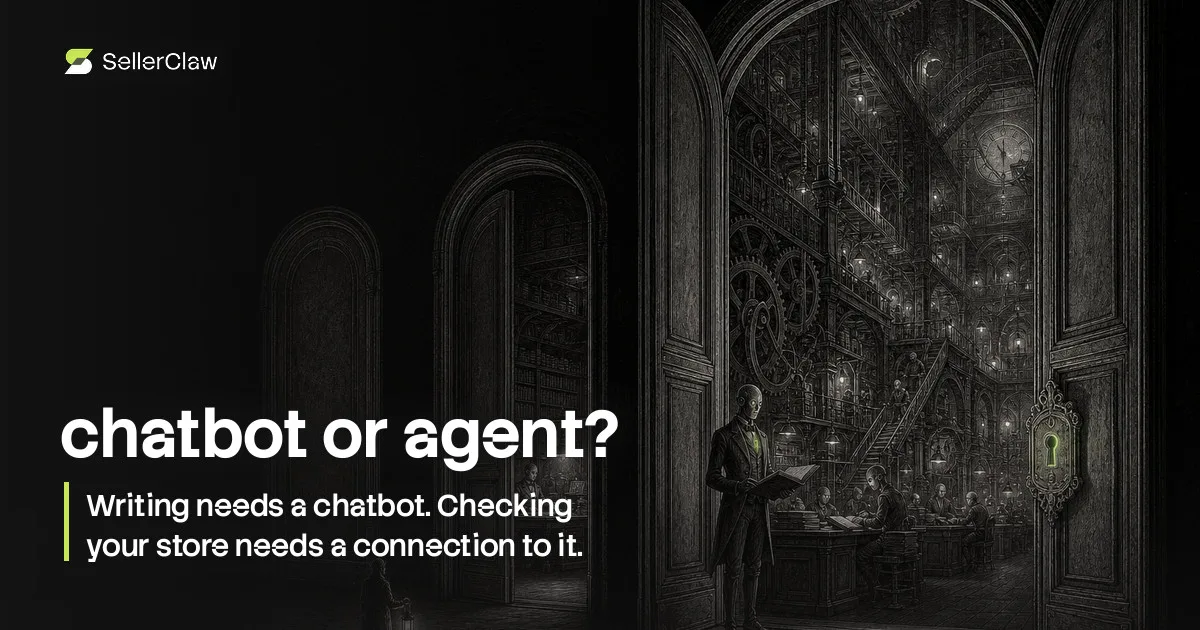
The rule that holds up: if the work is writing, a chatbot is enough. If the work is checking, you need something connected.
Most of what drains a seller's week is checking. Which orders are late, whether stock matches across storefronts, whether an ad is spending on something that never sells, what a marketplace rejection actually means. None of that is hard thinking. All of it requires looking in four places, and no amount of model quality substitutes for access.
SellerClaw is the third kind: a team of AI agents that connects to the stores you already sell on, plus your suppliers and ad accounts, and that you talk to in a chat, in plain language, with nothing to install. If you already have an assistant you like, you can point it at the same data instead.
The test on day one is not "write me a product description" — every category above passes that. Connect one store, on free credits, and ask a question you genuinely do not know the answer to. Whether you get a real answer or a polite framework tells you which of the three you have been using all along.
Common questions
What is the difference between an AI agent and a chatbot?
Access, not intelligence. A chatbot only knows what you type into it, so it can never check a claim you make about your own business. An AI agent is given credentials to your systems and permission to act in them, so it can answer with your actual numbers — including the answer you did not want to hear.
Is ChatGPT a chatbot or an AI agent?
On its own it is a chatbot: it works from what is in the conversation. It behaves as an agent when it is connected to systems that hold your data and given tools it can call — usually through MCP, a shared standard for handing an assistant a set of tools while the permission checks stay on the server that owns the data.
Is an AI agent the same as a bot?
No. A bot in the older sense follows a fixed script — a support flow with buttons, or a rule that fires on a trigger. An agent decides what steps to take and can carry work across several systems between conversations, which is why the meaningful question about one is not how smart it is but what it can do without asking you first.
What is the difference between an AI agent and a copilot?
Scope. A copilot lives inside one application — your store admin, your ad manager, your spreadsheet — and usually stops at suggesting, so you still press the buttons. An agent reaches across the systems a problem is spread over, which matters because most e-commerce trouble is made of facts that live in different places.
Do I need an AI agent for my store, or is a chatbot enough?
If the work is writing — descriptions, email drafts, translations — a chatbot is enough and you should not pay more. If the work is checking — which orders are late, whether stock matches across storefronts, whether an ad is spending on something that never sells — you need something connected, because no amount of model quality substitutes for access.
Keep reading
Connect one store and see what your agent says about it.
Start for Free