
Agentic Commerce: Soon the Buyer Will Be an Agent Too
In March, Shopify switched on agentic storefronts for eligible stores by default — meaning millions of catalogs became discoverable inside ChatGPT, Google's AI Mode, Gemini, Microsoft Copilot and Meta without their owners doing anything. Two months earlier, Google had used the retail industry's biggest conference to announce a shared protocol for AI agents to browse and buy, with Shopify, Walmart, Target, Best Buy, Visa and Mastercard standing behind it. In May, Amazon retired Rufus, its shopping chatbot, in favor of a shopping agent inside Alexa.
You can be skeptical about how much anyone is actually buying this way yet. It is harder to be skeptical about the direction, because the plumbing is being laid by everyone at once.
Here is the part that matters for a seller, and it has nothing to do with predictions: the thing reading your product page is changing, and it reads differently than a person does. A shopper skims and is persuaded. A machine filters and is not.
A machine's shopping question is a set of fields
Picture the request an agent is actually handed: waterproof hiking boots, men's size 11, under $120, in stock, delivered before Friday.
Every one of those is a field. Waterproof is an attribute, not an adjective. Size 11 is a variant. Under $120 is a price. In stock and delivered before Friday are live data, and if yours is wrong the agent finds out at checkout — which is a worse place to be wrong than a product page.
Now picture your listing. The word "waterproof" is probably in the description, in a nice sentence, next to "premium" and "perfect for weekend adventures." If the attribute field for water resistance is empty, you were not in that comparison at all. Not ranked low — absent.
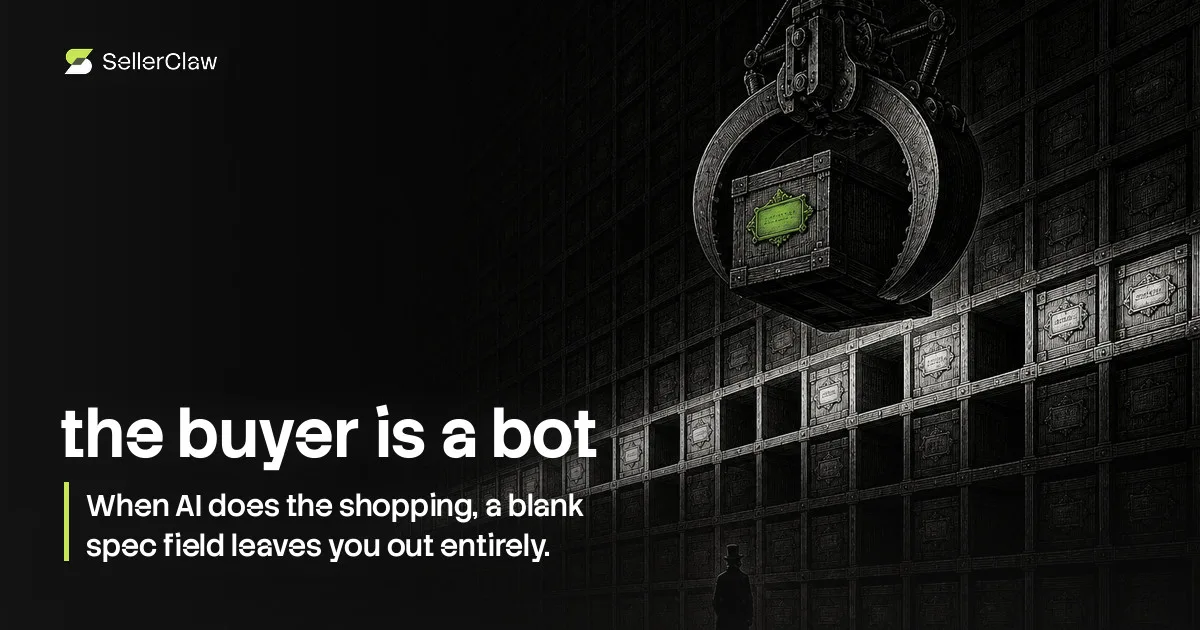
Last row on the right: the field the sentence on the left was supposed to cover.
This is why the guidance from the platforms themselves is so unromantic. Shopify's own description of what these AI surfaces reward is "structured data, with clean attributes and real-time accuracy." No mention of copy.
Adjectives were doing a job that no longer exists
For twenty years, listing copy did two jobs at once: it carried keywords for search, and it did the persuading once a human arrived. Both jobs assumed the same reader.
An agent splits them. It uses structured fields to build the shortlist, and it will happily quote your description to the buyer afterwards — so the copy still matters, but only for items that already made the cut. Persuasion moved downstream of a filter you cannot talk your way past.
The uncomfortable version of this: the fields you have been leaving blank because "nobody reads them" were the only part a machine reads. Material, dimensions, compatibility, model number, country of origin, the identifiers you skipped because the item is generic. Those are now closer to the title in importance than to the fine print.
The tempting response is to fill every field with whatever ranks. Don't — an attribute that turns out to be wrong comes back as a return or a claim, and those land in the metrics that decide your account level. Machine-readable and true is an asset; machine-readable and wrong is a defect with a delay on it.
What to actually do this month
Nothing here requires believing any particular forecast. It is the same work that improves marketplace search today.
Take your ten best sellers. Open the category's attribute list on each marketplace and fill everything the category offers, not everything that is required. Make sure stock and price are accurate in real time rather than nightly. Keep the description doing what descriptions are good at — answering the question a person has after they have already found you.
The reason this rarely gets done: it is dozens of fields across several storefronts, and it pays off invisibly.
That is the kind of work we built SellerClaw for: a team of AI agents that connects to the stores you already sell on, which you talk to in a chat. Ask it which of your listings are missing attributes their category supports, and it goes and looks — across every channel, from one catalog — instead of handing you advice about attributes.
Connecting a store and asking that one question costs nothing but the free credits. Whatever you believe about agents doing the shopping, an answer to "what is blank on my best sellers" is worth having before the buying starts — and September is when it is still cheap to fix.
Keep reading
Connect one store and see what your agent says about it.
Start for Free