
Tell It the Goal, Not the Steps
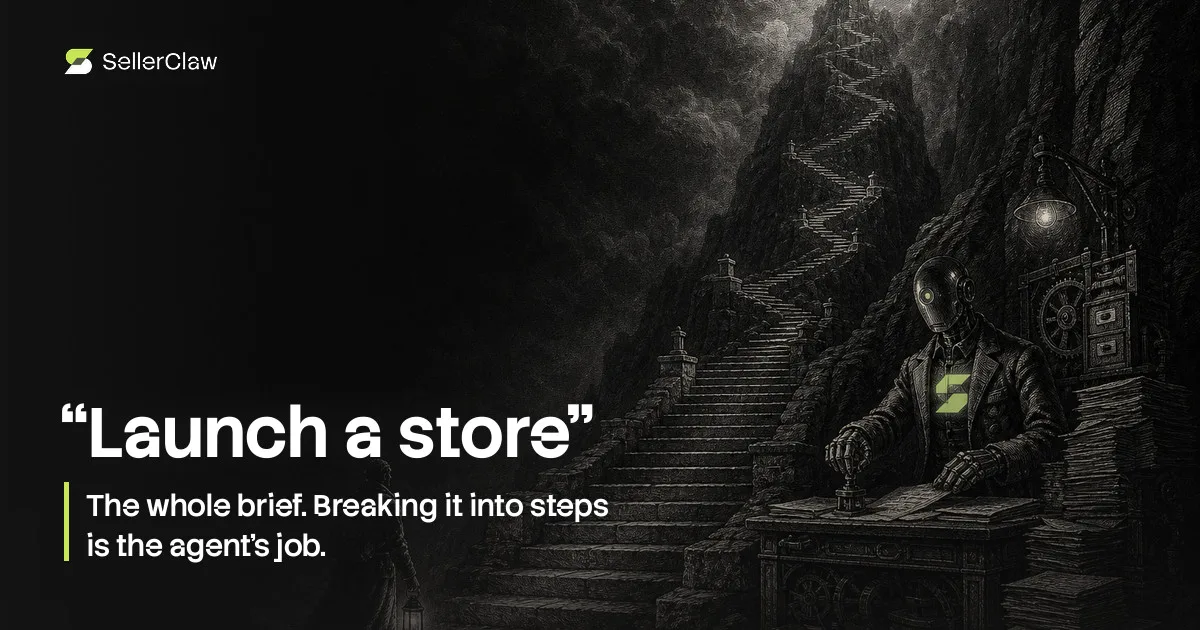
Every tool that automates work asks you the same thing first: what exactly should I do? Which product, which field, which value. You have to know the steps before you get any help with them.
That's fine when you know the steps. The problems that keep sellers up at night are the other kind: launch this store, make this niche work, get the first paid orders. Nobody wants those as a checklist. They want them handled.
A goal is a different unit of work
Each goal is a sentence about an outcome, with a status of its own.
These are real goals from an account: Launch a Dropshipping Store in 30 Days. Get Shopify Dropshipping Orders — "start generating paid orders by improving the product offer, store readiness, and the traffic path from product discovery to checkout". Validate 2 Dropshipping Niches and Product Shortlists — completed.
None of them is a task. Each is an outcome that takes a dozen tasks, in an order that isn't obvious until you start.
SellerClaw — a team of AI agents connected to your stores, suppliers and ad accounts — takes the goal and does the breaking down: it plans the steps, runs them, and comes back with what happened. You talk to it in a chat, in plain language.
Why the plan matters more than the execution
Goals usually stall because the next step was never decided.
You research a niche on Sunday, feel good about it, and on Wednesday the momentum is gone because "find suppliers" is vague and there's an easier tab open. A plan that exists — even an imperfect one, with the steps in an order and a next action at the top — converts that into work that continues.
That's what you get here: the goal keeps a plan, the plan keeps moving between conversations, and each finished step reports what it produced rather than just going quiet.
Under each step, what it actually found — prices from four comparable listings, then the competitor's ad and social footprint. Long work runs in stretches, reported and picked up again — you see a goal moving, not three weeks of unattended activity discovered after the fact.
You stay the one who decides
An agent that pursues a goal without limits is a bad idea, and this one has them.
Money and messages sent in your name are still gated: ad spend, campaigns and customer replies wait for your yes. Steps that need something only you can do — a marketplace account, a card, a login — come back to you as requests rather than silently failing.
It won't invent facts to fill gaps in a plan, either. Where it doesn't know — your margins without supplier costs, your policies without documents — it asks, or says so in the plan.
And a goal isn't a promise. Get the first paid orders depends on a market that gets a vote. What you're delegating is the work and the remembering, not the outcome.
What changes for you
Right now the size of your ambition is limited by how much of it you can hold in your head on a Tuesday evening. Goals move that somewhere else.
Open a goal, write it as an outcome — launch this store, make this niche profitable — and let it come back with the plan; free credits cover that first plan. Correcting a plan takes two minutes. Making one takes an evening you keep postponing.
Keep reading


Connect one store and see what your agent says about it.
Start for Free