
Teach It Once
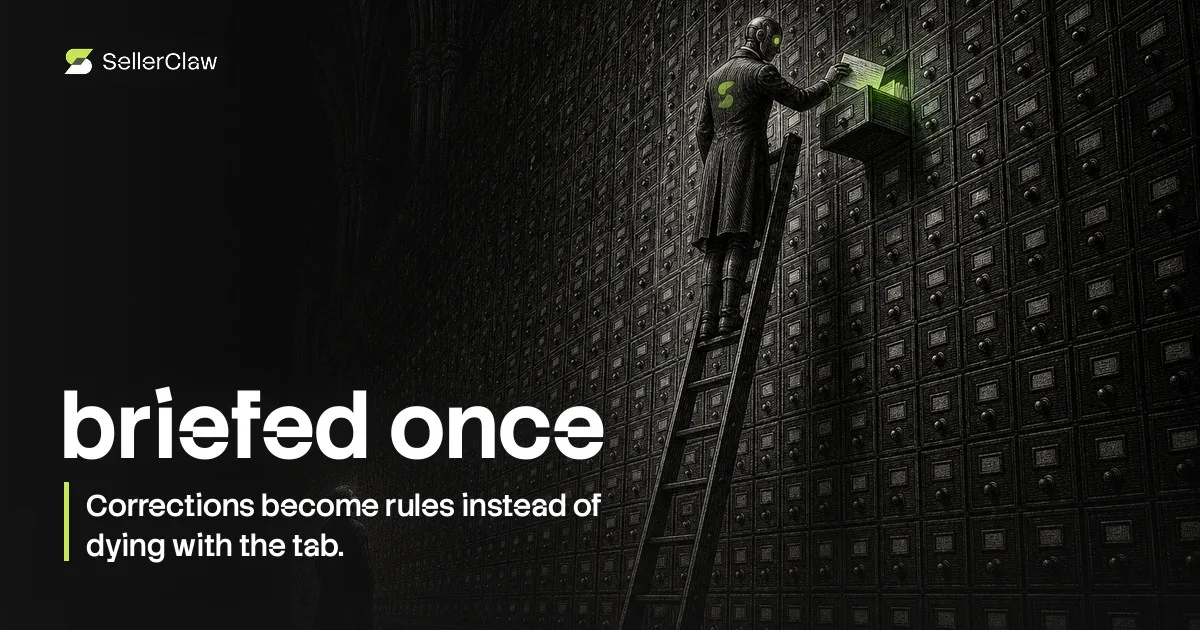
The tiring part of working with an AI assistant is the briefing: your brand, your tone, your margins, the supplier you don't use any more, the thing you asked for last week and don't want to explain again.
A colleague needs that once. A chat window needs it every time you open a new one.
Four kinds of knowing, doing different jobs
Four cards, four different jobs — each holding a different kind of knowledge.
SellerClaw — a team of AI agents connected to your stores, suppliers and ad accounts — separates them on purpose, because they behave differently:
Rules are how the team should always behave. Always reply in Spanish. Never publish without a photo. Prefer EU suppliers. Short, absolute, applied everywhere.
Memory is facts it keeps about your business — which campaign was approved, what a supplier said. On a working account they run into the hundreds, accumulated from the work itself rather than typed in.
Knowledge base is documents it can look up while working: your returns policy, a brand guide, a supplier's price list.
Skills are step-by-step playbooks for recurring jobs — a library of them built in, plus any you add.
The split matters because the wrong container makes knowledge useless. A returns policy as a "rule" would be ignored half the time; as a document it's looked up when a refund question actually appears.
Where memory comes from
You can add facts by hand, but most arrive from work you were doing anyway. Approve a campaign, pick a supplier, tell it your warehouse is in Poland — that's the kind of thing that gets kept.
Nobody typed these in. Each one is the residue of a decision — which listing went live, at what markup, which campaign was stopped.
Which is also why it's visible and editable rather than a black box. You can read what it believes about your business, and delete what's wrong. An agent that has quietly remembered something incorrect is worse than one that remembers nothing, so the list is yours to audit.
The boundary is just as visible: knowledge lives per account and per team. A document you never uploaded isn't secretly known because it exists on your laptop.
Teaching is how delegation actually works
The reason this page exists is that "do it like last time" only works if there is a last time that was recorded.
The first month with any assistant is spent correcting: wrong tone, wrong currency, wrong assumption about your shipping. Taste, in particular, can't be inherited from nothing — if nobody ever says the brand voice is dry and technical, you get the same enthusiastic marketing copy everyone else gets.
In a chat window those corrections evaporate when the tab closes. Here each one can become a rule, a fact or a document — and the second month is quieter than the first.
What changes for you
The value compounds in a way that's easy to miss on day one. A fresh agent with no rules is a competent stranger. The same agent after a month of corrections is the one who knows your suppliers, your margins and how you like listings written — and that difference is stored, not remembered by you.
Start free, and add one rule today: the thing you've already corrected twice this week.
Keep reading


Connect one store and see what your agent says about it.
Start for Free